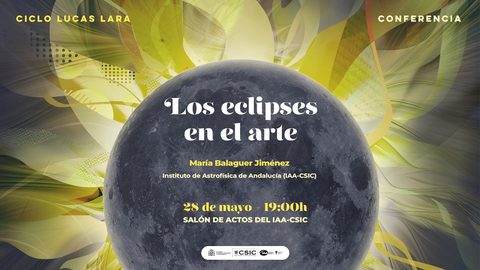
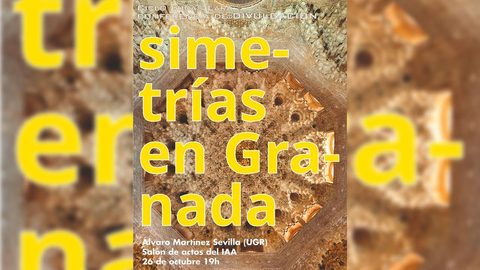
Esta charla propone un recorrido por distintas manifestaciones artísticas inspiradas en los eclipses solares a lo largo de la historia, desde la Antigüedad hasta el arte contemporáneo. A través de diferentes periodos y culturas, exploraremos cómo este fenómeno celeste ha sido interpretado, representado y transformado en imágenes y obras de arte que reflejan la profunda fascinación que el eclipse ha ejercido sobre la humanidad.
María Balaguer Jiménez ofrece un recorrido histórico y artístico por la presencia de los eclipses solares en la cultura humana, abordando este fenómeno no desde la física estelar, sino como una poderosa metáfora visual cargada de simbolismo, emoción y misterio.
La ponencia transita desde los primeros indicios en el arte prehistórico y las mitologías de la Antigüedad —como las tradiciones china, babilónica, egipcia y maya— hasta la pintura renacentista y romántica. En este trayecto se examina en detalle el célebre eclipse de la crucifixión, explicando las razones astronómicas que desmienten su realidad física pero analizando su enorme repercusión en obras de Taddeo Gaddi, José de Ribera o Rubens.
Finalmente, la charla explora las vanguardias del siglo XX y las manifestaciones contemporáneas, desde el expresionismo, el cubismo o el surrealismo hasta el arte pop y las instalaciones inmersivas. A través de figuras como Howard Russell Butler —cuyos detallados óleos de la corona solar sirvieron a los astrónomos de su época—, Dalí, Grosz o Paterson, se muestra cómo el eclipse ha simbolizado desde el caos bélico y la denuncia social hasta la fascinación por el orden cósmico.
Ideas clave
A lo largo de la historia, las civilizaciones antiguas interpretaron los eclipses de Sol como malos augurios, castigos o alteraciones del orden cósmico.
La cultura babilónica fue la primera en predecir eclipses con precisión matemática al identificar el ciclo de Saros de 18 años y 11 días.
El relato bíblico de la crucifixión no pudo corresponder a un eclipse solar real, pues la Pascua judía se celebra en luna llena y los eclipses de Sol exigen luna nueva.
En el Renacimiento y el Romanticismo, el eclipse sirvió para plasmar la fascinación por el universo y experimentar con los contrastes entre luz natural, sombras y luces artificiales.
Howard Russell Butler retrató la corona solar y las perlas de Baily con tal fidelidad documental que sus pinturas superaban a la fotografía de la época y fueron empleadas por científicos.
En el arte contemporáneo, el eclipse solar se transformó en una metáfora visual para la crítica política, los estados psicológicos y la denuncia de crisis sociales.
Glosario
Eclipse solar
Fenómeno astronómico que ocurre durante el día cuando la Luna se interpone entre la Tierra y el Sol, ocultando total o parcialmente la luz solar.
Ciclo de Saros
Periodo de 18 años y 11 días descubierto por los babilonios tras el cual se repiten alineaciones geométricas y eclipses solares muy similares.
Luna nueva
Fase lunar en la que la Luna se ubica exactamente entre el Sol y la Tierra, condición geométrica indispensable para que suceda un eclipse de Sol.
Corona solar
Capa más externa de la atmósfera del Sol, constituida por material muy tenue que se hace visible a simple vista durante la fase de totalidad de un eclipse.
Perlas de Baily
Puntos luminosos que aparecen justo antes o después de la totalidad de un eclipse solar, causados por la luz del Sol filtrándose entre los valles y montañas de la superficie lunar.
Esfera armilar
Instrumento astronómico clásico compuesto por aros concéntricos graduados que reproducen los círculos de la esfera celeste, utilizado para realizar mediciones y cálculos posicionales.
Transcripción completa
Lee la charla de principio a fin
1:01:25 de charla
7.139 palabras
Español · English
Cada párrafo lleva su minuto: púlsalo y el vídeo empieza justo ahí.
Buenas tardes a todos y bienvenidos. Hoy estamos aquí para celebrar una entrañable efeméride. Imaginen que viajamos en el tiempo exactamente 30 años atrás. Es mayo de 1996. En ese momento Internet daba sus primeros pasos y no había redes sociales. Imaginaos.
Pero aquí mismo, en Granada, el Instituto de Astrofísica de Andalucía decidió encender una chispa de comunicación. Nacía el ciclo de conferencias Lucas Lara. Pero no nació como un aula fría ni como un ciclo de lecciones magistrales. Nació en el espíritu de fundar algo mucho más cálido y emocionante: un genuino club científico. Un club en el sentido más puro de la palabra. Un espacio de encuentro donde el último jueves de cada mes se rompe la barrera entre el laboratorio y la calle. Aquí los científicos no vienen a subirse a un pedestal a dictar verdades absolutas. Vienen a sentarse con ciudadanos curiosos, apasionados e interesados en entender el mundo.
En este club no solo se comparten los titulares brillantes o las fotos espectaculares de los descubrimientos. Se comparte la trastienda de la ciencia. Se discute abiertamente cómo se obtienen esos resultados, los tropiezos del camino, las limitaciones de la tecnología actual y, por supuesto, la euforia de los grandes éxitos.
Y qué viaje tan fascinante ha sido. Tres décadas después este club sigue más vivo que nunca. Por su estrado han pasado más de doscientas mentes brillantes a lo largo de más de 265 noches de ciencia. Investigadores del CSIC, astrofísicos que diseñan misiones para la NASA o la Agencia Espacial Europea, profesores universitarios de Granada, astrónomos aficionados e incluso cirujanos y expertos en inteligencia artificial.
Juntos, científicos y ciudadanos hemos explorado los misterios del espacio-tiempo, los secretos de los agujeros negros o la geología de Marte. Pero también hemos debatido sobre los desafíos éticos de la inteligencia artificial, el impacto ambiental de las constelaciones de satélites o los retos de la reproducibilidad en la ciencia abierta. Hemos aprendido a mirar la ciencia no como un dogma...
¿Tenemos problemas con el directo? Bien. Ahora mismo me oís, ¿no?
...en la órbita en el que digamos se anulan muchas fuerzas de gravedad, es un punto de gran estabilidad. PMI podrá observar regiones activas del Sol antes de que queden orientadas hacia la Tierra, proporcionando varios días adicionales de aviso ante tormentas solares potencialmente peligrosas.
Desde 2018 hasta 2023 fue responsable de la Unidad de Desarrollo Instrumental y Tecnológico, la UDIT, del Instituto, unidad dedicada al diseño, fabricación y verificación de instrumentación astronómica para observatorios terrestres y misiones espaciales. Entre sus funciones destacan la supervisión de proyectos, la gestión de recursos y la coordinación de servicios científico-técnicos.
Dicho esto, que es el resumen de la biografía oficial y profesional de María, querría añadir que nuestra conferenciante de hoy representa lo mejor de esta casa. Ese grupo de científicos e ingenieros jóvenes que lideran los proyectos más vanguardistas de la investigación astronómica mundial. Y lo hacen con un estilo propio y envidiable: conocimiento, responsabilidad, trabajo, humildad y buen humor.
Gracias, María, por tu trabajo cotidiano y por estar esta noche con nosotros. Y a todos vosotros os invito a seguir formando parte de esta maravillosa conversación, a mantener encendida esa sana rebeldía de querer saber el cómo y el por qué de las cosas, y a celebrar con el corazón y la mente este aniversario. Por otros 30 años de ciencia, debate y pasión compartida. Muchísimas gracias.
Emilio, tu teléfono está aquí por si lo quieres.
Bueno, antes de nada, buenas tardes a todos. Muchas gracias por venir y gracias, Emilio, por esa presentación tan bonita. Yo me uno al tema estrella de este año y de los próximos años, que son los eclipses solares, por el trío de eclipses que vamos a presenciar en España en los próximos años.
Pero mi charla...
Mi charla está centrada en los eclipses solares, pero desde un punto de vista diferente al que se suelen tratar los eclipses, porque no voy a hablar de ciencia. Voy a tratar el eclipse como una potente metáfora visual que, como veremos, ha dado lugar a un montón de leyendas y de historias a lo largo de las civilizaciones, que artistas de todas las disciplinas y de todo tipo han utilizado para crear una gran variedad de obras de arte. Mi charla será, por lo tanto, un recorrido de ese tipo de obras que se han creado inspiradas todas por eclipses solares.
El arte a lo largo de la historia de la humanidad no se ha utilizado simplemente para buscar belleza, sino que ha sido un medio para expresar aquello que nos preocupaba, nuestras emociones más profundas, como miedo, angustia, temor, amor. Por lo tanto, se ha utilizado durante los distintos periodos de la historia para representar aquello que nos preocupaba más. En cada momento había unas características determinadas; por ejemplo, en la prehistoria había temor, miedo y respeto hacia la naturaleza, y el arte lo vemos como una forma de enfrentarse a ese miedo e intentar controlar lo desconocido. En las civilizaciones antiguas, el arte expresó ese temor a los dioses y fenómenos naturales que no se comprendían. En la Edad Media, el arte estuvo totalmente ligado a la religión y era una herramienta para canalizar la culpa, la fe y la esperanza de salvación. En el Renacimiento se explora la belleza, la razón, la dignidad humana y una serie de conflictos internos y espirituales. En el Romanticismo y en el Expresionismo, que veremos que también hay muestras de obras influidas por eclipses, se centra más en la representación de emociones individuales. Y por último, tanto en el siglo XX como en el XXI, el arte se utilizó como un espacio de denuncia y reflexión, como un medio para expresar ese horror, ese sufrimiento de una serie de conflictos que tuvieron lugar y de violencia colectiva.
En esta primera transparencia he incluido un par de ejemplos de arte rupestre, pintura rupestre, y una tumba neolítica, prehistórica, que bueno, es mucho suponer que realmente representan un eclipse porque no lo podemos comprobar y contrastar, pero sí nos invitan a pensar que lo que se está representando podría ser un eclipse. En esta figura de arriba, el Sol y quizá una luna que se va aproximando y lo va cubriendo. En esta tumba neolítica, también esa serie de círculos concéntricos que se superponen ha dado a algunos investigadores a pensar que podría tratarse de eclipses solares.
Si pasamos a estudiar las culturas de la Antigüedad, una característica común de todas ellas es que miraban al cielo como ese lugar donde habitaban los dioses y los héroes, que eran los creadores de todo lo terrenal. Prácticamente en todas las culturas de la Antigüedad vemos que la importancia del dios Sol era enorme y, de hecho, un ejemplo de ello es que cada una lo llamaba de una manera diferente, pero todas veneraban a ese dios Sol: la cultura egipcia con Ra, las culturas mesopotámicas con Shamash, principalmente asirios y babilonios, Inti para los incas, Helios para los griegos, Amaterasu en la mitología japonesa, y en la mitología china, por supuesto, también estaba muy presente a través de una gran variedad de dioses.
El dios Sol era tan importante porque era la fuente principal de vida y fertilidad. Estas civilizaciones estaban basadas, su subsistencia dependía mucho de la agricultura: si no hay Sol, no hay cosecha y, por lo tanto, no tenemos alimento. El orden del universo: también ese ciclo del Sol que por la mañana sale y por la noche se pone era símbolo de orden del universo y de organización de su vida. Hay muchos mitos del dios Ra amenazado durante la noche. También era símbolo de poder político y divino, por eso muchos emperadores eran representantes de estos dioses en la Tierra, y también de ese ciclo eterno de la existencia: de nacer, renacer y morir.
Si nos centramos en la palabra «eclipse», deriva de una antigua expresión griega que significa «abandono», y hace referencia a esa desaparición momentánea de la luz. Entonces, pensando en un eclipse solar, es normal que de todos los fenómenos astronómicos sea el que más ha asombrado y el que más ha inquietado a las distintas civilizaciones. Porque, durante el día, de pronto un momento en el que el Sol empieza a ocultar, empieza a desaparecerse, el día se hace noche, una sensación de que el orden normal parece alterarse. Entonces esto solo podía interpretarse como un mal augurio, un castigo de los dioses o un enfado divino. Por lo tanto, era muy importante intentar entender qué estaba pasando con el Sol.
Si nos fijamos en la cultura china, el emperador era una especie de intermediario entre los dioses y lo que pasaba en la Tierra, y los eclipses y todos los fenómenos astronómicos eran un asunto imperial. De hecho, prácticamente todos los emperadores contaban con sus astrónomos, que tenían una labor muy importante dentro del Imperio. Esto dio lugar a la creación de observatorios y registros astronómicos extremadamente detallados y continuos. Luego hay una serie de leyendas que tampoco están contrastadas ni verificadas. Se habla de un eclipse el 22 de octubre de 2134 antes de Cristo, que está ligado a una leyenda de dos astrónomos imperiales, Hsi y Ho, que no fueron capaces de predecir ese eclipse y, por lo tanto, fueron duramente castigados con la muerte. Esa fecha del eclipse y la veracidad de esta historia es muy cuestionada, porque aparecen en algunos textos, pero son textos muy posteriores, con lo que no hay manera realmente de saber si realmente ocurrió. En la cultura china el eclipse aparece muy representado, tanto en relieves como en vasijas, en telas incluso, y se representa como un dragón devorando al Sol. Esto iba acompañado de una serie de rituales con tambores e incluso arqueros disparando flechas para intentar ahuyentar al dragón.
La cultura babilónica fue muy importante si queremos hablar de eclipses solares, porque fue la primera que consiguió predecir eclipses con cierta precisión. También contaba con sus astrónomos sacerdotes, que formaban parte de toda la corte imperial o de los dirigentes de la época, y los eclipses eran interpretados como señales divinas, pero fue la primera civilización con la que pasamos del mito a la observación sistemática. Estas observaciones quedaban reflejadas en tablillas cuneiformes, que eran una especie de diario astronómico babilónico, y es importante destacar la tablilla encontrada en Ugarit, que relata, este sí contrastado, el eclipse solar del 5 de marzo de 1223 antes de Cristo. También estas observaciones y esta serie de cálculos que realizaban les llevó a tener cierta predicción matemática, y es importante destacar el ciclo de Saros, que observaron cómo cada 18 años y 11 días se producían o podían producirse eclipses solares parecidos. A pesar de este desarrollo de esta civilización en el estudio de los eclipses y en la predicción de ellos, hay muy pocas representaciones artísticas explícitas de estos fenómenos, más allá de las tablillas cuneiformes.
Avanzamos un poco y llegamos a la cultura egipcia. Aquí, a pesar de ser una de las más avanzadas de su tiempo y de que su duración fue un periodo histórico muy importante, no hay prácticamente ninguna representación artística y muy pocas evidencias de un eclipse solar explícito, aunque se sabe que durante la duración de esta civilización hubo varios. Hay un mito, el mito de la serpiente del caos, que podría simbolizar eclipses solares, aunque realmente no se muestran como un eclipse. Esta serpiente intentaba destruir la barca de Ra, que hacía el viaje nocturno para volver a aparecer durante el día. Eso ha aparecido en diferentes formatos como papiros, frescos y relieves. Aparece de diferentes formas representada: bien la serpiente rodeando a Ra, o aquí rodeando el Sol.
Hay otro ejemplo de arte egipcio en el que se cree que podría representarse un eclipse solar, que es el zodiaco de Dendera; es una bóveda de un templo... del templo de Hathor en Dendera, aunque actualmente se encuentra en el Louvre. Aquí aparece un círculo con una figura con un animal, prácticamente imposible saber qué tipo de animal es, y esto se cree que podría representar un eclipse solar, pero bueno, son teorías.
Se cree que esta civilización no representó los eclipses solares de manera explícita, quizá por algún tipo de superstición o de miedo hacia lo que podría suponer.
Pasando a las culturas precolombinas, también entendieron los eclipses solares como eventos cósmicos cargados de poder. Eran ciclos de creación-destrucción asociados a presagios, pero también fueron capaces de alcanzar conocimientos astronómicos avanzados que les permitió predecir alineaciones entre el Sol y la Luna y, por lo tanto, eclipses solares, a partir del conocimiento de esos ciclos de la Luna y del Sol.
Los conocimientos astronómicos de la cultura maya se plasmaban en códices, como este ejemplo que he puesto aquí, que es el Códice de Dresde del siglo XII. Es una serie de documentos doblados en forma de biombo y aquí, en este, podemos ver un eclipse solar. El eclipse solar aparece representado como el Sol aquí en el centro, dos huesos fémur cruzados simbolizando la muerte, y detrás una especie de alas de mariposa que representan la oscuridad de la Luna superponiéndose en el Sol. Lo llamaban «fuego muerto», y era una forma muy común de representar eclipses solares.
Pasamos ahora a hablar del eclipse de la crucifixión, que es un eclipse muy conocido y, como veremos a continuación, muy representado, pero muy cuestionado y con mucha certeza de que no fue realmente un eclipse. En los evangelios de Lucas, Mateo y Marcos habla de una oscuridad durante las horas previas a la crucifixión. Bueno, ya aquí empieza mal porque un eclipse no dura horas, son minutos.
Luego, otro punto también importante a tener en cuenta es que la crucifixión tuvo lugar en la Pascua judía, que coincide con una luna llena, y los eclipses solares solo pueden ocurrir en luna nueva. Si nos fijamos en este diagrama que he incluido aquí, luna llena es imposible tener un eclipse solar porque la Tierra está entre el Sol y la Luna. El eclipse solar solamente puede tener lugar cuando tenemos luna nueva, porque la Luna está delante del Sol. A pesar de esto, está en un montón de ejemplos que veremos a continuación, y se ha simbolizado como símbolo de la pasión de Cristo.
A continuación, quería mostrar algunos ejemplos de este eclipse tan conocido y tan famoso. Empezamos con este tríptico de Taddeo Gaddi, de alrededor de 1330. Aquí el eclipse se representa con la Luna y el Sol a los dos lados de la cruz, simbolizando que la Luna va avanzando y se acerca al Sol. Y esta cuña negra que hay en esta parte superior simboliza a ese oscurecimiento que tiene lugar cuando sucede un eclipse solar.
Otro ejemplo está en este anónimo valenciano titulado Crucifixión, de aproximadamente 1450, en la que el eclipse se representa a través del Sol, con un tono ocre y una superficie cuarteada que nos muestra que la Luna está por encima del Sol. Aquí es curioso destacar que no hay ninguna oscuridad en el cielo, es un cielo totalmente normal, probablemente porque el autor jamás había visto un eclipse solar ni tampoco sabía muy bien en qué consistía.
Otro ejemplo más lo tenemos en el Cristo crucificado de José de Ribera. Aquí sí tenemos ese oscurecimiento del cielo, y la Luna traslúcida deja ver el Sol detrás, lo que nos muestra que es un eclipse.
Otro ejemplo más sería en este tríptico de La elevación de la cruz de Rubens, en el que se muestra un eclipse en su fase inicial. Es cierto que Rubens marcó mucho el contorno de la Luna, que es algo que no se observa así en la realidad, pero de manera que fuera claramente identificado ese eclipse solar.
Pasamos al Renacimiento y, como veremos, también hay aquí varios ejemplos de arte basado en eclipses solares. Empezamos con el Libro de los milagros de Augsburgo, que es un manuscrito ilustrado del Renacimiento alemán. Está realizado en acuarela y gouache, con colores muy vivos y composiciones dramáticas. Mezcla episodios del Antiguo Testamento con fenómenos astronómicos, criaturas extrañas, cometas, eclipses, escenas del fin del mundo, todo muy dramático. En una de sus láminas aparece esta representación de un eclipse solar con la Luna totalmente cubriendo el Sol y mostrándonos la corona solar, que tuvo lugar en Italia en 1484 y acompañado de una plaga de langostas, que también se muestra en la imagen, seguido de una gran epidemia. En esta obra todas las representaciones de los eclipses son muy dramáticas, con mucha carga emocional y mucha carga espiritual.
Seguimos con más ejemplos de eclipses en el Renacimiento, y aquí quería introducir la figura de Dionisio Areopagita, que fue un noble y juez ateniense que, según cuenta la leyenda, fue testigo del eclipse de la crucifixión. Y una frase que pronunció: que si el dios de la naturaleza sufre, la máquina del mundo se desintegra; de manera que como perdemos el orden de las cosas y todo se altera. Este personaje ha sido representado en varias obras relacionadas con los eclipses, que indirectamente volvemos a hablar del eclipse de la crucifixión. En este primer ejemplo, aparece en el centro con la mano levantada hacia arriba, hacia el cielo, y señala a lo que sería un eclipse solar. El Sol está con un tono rosáceo y tiene una nebulosa alrededor amarilla que mostraría la corona. Está rodeado de una serie de personajes con atributos que nos invitan a pensar que son astrónomos o por lo menos hombres de ciencia, con una esfera, aquí tiene una esfera armilar que se utilizaba para hacer mediciones, con cálculos, y se cree que aquí en esta columna se representaría a Urania, la musa de la astronomía. Muy típico también de esta época es introducir la arquitectura en la pintura para dar imagen de orden, de intelectualidad.
Volvemos otra vez a este mismo personaje, que aparece representado en este fresco de Pellegrino Tibaldi que está en la biblioteca de El Escorial y que nos recuerda un poco a los frescos de la Capilla Sixtina. De nuevo aparece Dionisio como figura central observando el eclipse de la crucifixión, y de nuevo rodeado por una serie de personajes con atributos que nos muestran que se dedicaban a la ciencia. Este tipo de obra y de representación del eclipse es una muestra de la fascinación renacentista por comprender el orden del universo.
Pasamos al Romanticismo y aquí he incluido dos muestras de obras dedicadas a eclipses de Sol. Una de ellas es este Eclipse de Sol en Venecia, de Ippolito Caffi. Aquí se representa también un eclipse real del 8 de julio de 1842 desde una perspectiva aérea, en el que el autor pretende mostrar ese cambio de oscuridad y luz, pero de una manera un tanto extraña y poco realista. Al tener el horizonte tan bajo en esta obra, la mirada se va directamente al cielo y a ese eclipse solar. Esta escena está en la plaza de San Marcos, aunque no es fácil reconocerla, y aparecen una serie de personajes en primer plano, algunos interesados por el eclipse, mirando hacia el cielo, incluso señalándolo, y otros en sus cosas.
Otro ejemplo más de pintura romántica con un eclipse solar como motivo principal es este Eclipse solar en Feodosia de Iván Aivazovski, que representaría también un eclipse observado en este lugar en 1851. En este tiene el mar como protagonista, también con un horizonte bajo, de manera que se le da mucha importancia al cielo y lo que está pasando en él. Y es importante señalar que también se busca ese contraste entre oscuridad y luz: por una parte, la luz natural oculta por el eclipse solar, y por otra parte, luz artificial creada con hogueras en este primer plano de la gente que está en la playa, que también observa y señala al eclipse.
A partir de este momento llega otra manera de entender el arte. Llegamos a lo que sería el arte moderno, a finales del siglo XIX y XX, donde hay una ruptura con lo que se entendía hasta ese momento como arte tradicional. Se buscan nuevas formas de expresión, se experimenta con los colores, con la forma, con la técnica, y ya no es tan importante representar lo que vemos con fidelidad, sino que es más importante la subjetividad, la emoción. Se potencia también mucho la libertad y la innovación creativa, y surgen una gran variedad de estilos que se enmarcan dentro de este periodo. He introducido este esquema y este recordatorio del arte moderno porque, si nos fijamos en lo que puede simbolizar un eclipse solar, viene muy bien con este tipo de ruptura del arte que había hasta ese momento. El eclipse se puede emplear como una metáfora de significado simbólico, emotivo y político; momentos de cambio, donde lo conocido, que es la luz, desaparece; enfrentamiento entre opuestos: claridad y oscuridad, vida y muerte; símbolos de situaciones de pérdida, de caos, de peligro, o que están muy relacionadas con crisis colectivas, periodos de guerra; y también representación de lo que está más allá de lo racional. Como veremos a continuación, también hay bastantes ejemplos de este tipo de estilo que han utilizado un eclipse como base para su obra.
Empezamos con el expresionismo y volvemos al eclipse de la crucifixión, que, para no haber existido, se ha representado ampliamente. Esta obra es de 1907, de Egon Schiele, y vemos una escena de la crucifixión no tradicional, no tiene nada que ver con los ejemplos que hemos visto anteriormente. Aquí la narrativa religiosa deja de ser importante y el centro de atención son los rostros, la figura estilizada, esta figura retorcida que está en el centro, y el eclipse se utiliza para crear esa atmósfera emocional, ese paisaje simbólico, y dar un amplio sentido espiritual y psicológico a la obra.
Continuamos con el expresionismo y encontramos otra artista, rusa en este caso, Marianne von Werefkin, que fue una de las pocas mujeres representantes y destacadas de este movimiento artístico. En su dilatada obra hay al menos dos ejemplos de óleos dedicados a un eclipse solar. Uno de ellos es este que pintó en 1910 aproximadamente, y aquí la pintora se centra más en ese contraste entre la oscuridad que muestra en el primer plano y la luz de ese segundo plano, que todavía recibe algunos rayos de sol porque no está cubierto completamente por la Luna. En el segundo ejemplo es totalmente distinto, ya sí el eclipse es completo, y muestra a una pareja inmersa en sus pensamientos, está totalmente ajena a lo que está pasando, y utiliza en este caso el eclipse para crear esa atmósfera de intimidad y de reflexión que es la que tienen esos dos personajes en primer plano.
Más ejemplos del expresionismo encontramos en Paul Klee, en este caso con una acuarela en el que explora el contraste entre luz y oscuridad, una acuarela abstracta en la que utiliza una técnica que viene muy bien para representar un eclipse solar, porque encontramos veladuras, transparencias, diferentes gradaciones, que representan muy bien esas imágenes que podemos observar durante un eclipse solar. En este ejemplo de George Grosz es totalmente distinto, y se utiliza el eclipse solar como una metáfora y una crítica a la situación política. En este caso se representa una crítica a la situación de la Alemania de después de los años 20, de la República de Weimar, y aparece la clase dirigente representada aquí mediante este señor con una corona de laurel, y luego están sentados a la mesa una serie de personajes sin cabeza indicando que no piensan por sí mismos. El asno de la parte central simboliza al pueblo alemán, que atiende a razones sin cuestionarse lo que hace. Y el Sol aparece aquí eclipsado con un símbolo de dólar encima, dando a entender la dominación económica de Estados Unidos sobre Alemania en ese momento. Este sería un ejemplo de crítica política con un eclipse de trasfondo.
Avanzamos en los estilos artísticos y llegamos a este ejemplo cubista de Diego Rivera. En principio es un estilo que no habríamos esperado de Diego Rivera, que lo conocemos más como muralista. Hizo este retrato del escritor español Ramón Gómez de la Serna. Parece ser que durante su estancia en España lo conoció y compartieron muchos momentos de la vanguardia cultural de ese momento. Aquí se representa en el típico estilo cubista, con varios planos superpuestos, con diferentes colores. Representa al escritor con su pipa, que era un rasgo característico suyo, la pluma para indicar que es un escritor, papeles y libros. Aquí aparece una imagen de una ciudad por la noche, dando a entender la nocturnidad del escritor; aquí una cabeza de maniquí y una espada con pelo, que muestra la personalidad excéntrica de este escritor. Fue creador de un género literario propio, las greguerías, que mezclaban metáfora y humor. Y aquí el eclipse aparece oculto, muy difícil de encontrar, en su ojo. Y lo emplea como una metáfora visual de esa forma tan excéntrica y tan particular de pensar el autor, con ese humor extraño y esa visión parcial e intuición poética. Aquí he incluido también una fotografía de Diego Rivera y Frida Kahlo observando un eclipse solar en América, cuando estaba haciendo una serie de murales en Detroit.
Más ejemplos en otro estilo artístico, como el surrealismo, encontramos esta obra de Salvador Dalí, que se llama «Eclipse y ósmosis vegetal». Aparece representada aquí una luz naranja, que sería la luz que llega de un eclipse solar, que ilumina a un caballo que se está transformando en planta. Aquí Dalí lo representa como una fusión simbólica entre el cosmos, que sería el eclipse, y la vida orgánica, que son las plantas. Utiliza ese momento de oscuridad temporal para transformar la manera en que percibimos la realidad, y esa transición en la que se ha utilizado muchas veces el eclipse para mostrar el paso de lo visible a lo oculto, lo consciente y lo inconsciente.
Más ejemplos de surrealismo lo tenemos en esta obra de Max Ernst. Es una obra muy simple, con dos círculos: uno oscuro y otro claro. Aquí lo interesante de esta obra, que es muy sencilla y simbólica, es la técnica que se empleó. Mezcla una serie de materiales con texturas muy diferentes: es un collage de papel de lija y todo esto está pintado con cera, para crear esa diferencia de textura y esas características que encontramos en un eclipse solar: contraste entre lo táctil y lo visual.
Al hablar de arte y hablar de eclipses, no podemos olvidar a Howard Russell Butler. Fue un pintor americano que consiguió pintar los eclipses de una manera sin precedentes. De hecho, hubo científicos de la época que utilizaban sus cuadros para hacer sus investigaciones. Es curioso que, en el poco tiempo que dura un eclipse solar, fue capaz de tomar una gran cantidad de datos sobre la corona, estudiar brillo, textura... que luego plasmó de una manera impresionante en su obra. Y se ve toda la corona está muy bien representada, momentos del eclipse como las perlas de Baily o el anillo de diamante. Detallaba de tal manera, con tanto detalle, que ni siquiera la fotografía de la época era capaz de reproducir los eclipses tal como él lo hizo.
Tiene varias pinturas dedicadas a los eclipses, pero principalmente se centró en los del 18, 23 y 25, que aquí están mostrados como tríptico.
Avanzamos en el siglo XX y llegamos a otro ejemplo. Esta vez es una pintura acrílica de la artista afroamericana Alma Thomas, que pintó este eclipse en 1970. Forma parte de una serie Space, inspirada también en un eclipse real, que tuvo lugar el 7 de marzo de 1970 en la costa este de Estados Unidos.
Aquí la Luna se representa como este círculo central azul, y todos estos círculos representarían a la corona con diferentes tonalidades de color naranja. La autora eligió esta composición asimétrica para dar sensación del movimiento que tiene lugar en un eclipse solar.
Y estaba muy inspirada y muy interesada por todos los avances científicos de su tiempo y tecnológicos, y consiguió plasmarlo en su obra.
Avanzamos en el siglo XX y también en el arte pop encontramos ejemplos de obras dedicadas a eclipses solares.
Por una parte tenemos aquí a Andy Warhol, el mayor exponente del arte pop, en una de sus serigrafías tan famosas que se titula «Cuatro trabajos», de 1974, y en la que la parte superior está dedicada a Saturno y sus lunas, y esta parte inferior representaría eclipses solares, con una serie de planos de colores que se superponen y de círculos concéntricos, con esa idea de la Luna superpuesta por encima del Sol.
También dentro del estilo pop encontramos otro ejemplo más, en este caso de Roy Lichtenstein, llamado «Eclipse solar», de 1975, donde pretende transmitir ese movimiento que tiene lugar en un eclipse solar, a través de una serie de círculos superpuestos y líneas curvas que nos transmiten esa sensación de movimiento, en un estilo tan característico de él.
Pasamos ya al siglo XXI y volvemos a encontrar ejemplos de obras de arte dedicadas a eclipses. En este caso he elegido dos de Juan Genovés: un eclipse de 2003 y otro de 2006.
Ambos están representados desde una perspectiva cenital. En este caso se ve el Sol y un círculo representado por figuras humanas que parece que huyen.
Este pintor utilizaba el eclipse como una metáfora social para representar temas como opresión, oscuridad o pérdida de identidad. Por eso representaba una multitud huyendo y un poco deshumanizada, característica de la sociedad contemporánea.
Luego encontramos también otra obra que volvió a revisitar el tema del eclipse, en 2006, también con una perspectiva cenital, pero esta vez con un enfoque diferente, en el que también se ve una multitud de figuras un poco desorientadas.
Y llegamos ya al final con otro ejemplo de arte, esta vez una exposición inmersiva de la artista escocesa Katie Paterson, que se llama «Totality».
Consiste en una bola compuesta por más de 10 000 espejos que contienen imágenes reales de eclipses solares. Hay dibujos desde 1778 hasta fotografías de telescopios de eclipses más actuales.
Esta bola contiene un pequeño motor que va haciendo que se mueva muy lentamente, y va proyectando, en la habitación en la que se encuentra, todos esos eclipses: en las paredes, en el suelo y en el techo. Por lo tanto, crea una atmósfera muy bonita y una experiencia sensorial muy sobrecogedora para aquel que lo pudo observar.
Con esto terminaría mi recorrido por las obras de arte con el denominador común de un eclipse solar. Espero que lo hayan disfrutado y que se hayan sorprendido tanto como yo. Cuando empecé a investigar un poco sobre esto jamás pensé que había tantos ejemplos de obras dedicadas a un eclipse solar, con diferentes estilos y cada una simbolizando emociones distintas.
Bueno, por romper un poco el fuego, la verdad es que ha sido muy interesante, muy bonita, y desconocía absolutamente el 100 % de lo que has comentado.
Tengo una curiosidad que quiero transmitirte. Yo me pongo en situación en la Edad Media o anteriormente a eso, en la que soy un campesino, estoy en el campo y de pronto veo que el Sol se oscurece. No tengo más remedio que mirar a ver qué pasa, ¿no? Y como a mí, a tantísima otra gente de mi entorno, ¿no? Con los consecuentes problemas en los ojos, incluso en algunos casos pérdida de visión, ¿no?
Claro, eso me haría pensar: «He sido castigado». En aquella época en la que el desconocimiento... en fin, sería pensar que he sido castigado por mirar ese fenómeno, ¿no?
¿Hay realmente reflejo de ese miedo que pudieron generar los eclipses en la literatura, hablo ya en un momento en el que quedaban escritos y todo eso?
Hombre, yo creo que sí, porque era una situación tan extraña, tan desconocida, que incluso causaría ceguera seguramente.
Y sí, en la literatura hay ejemplos. Por ejemplo, hay batallas que se dejaron de ofrecerse porque ocurrió un eclipse solar.
También está la historia de Colón, que utilizó el eclipse para un poco atemorizar a la gente para que siguieran.
Sí que hay documentación indicando que esos eclipses realmente atemorizaban a la gente, porque era algo tan desconocido y tan inexplicable que, claro, culturas que veneraban tanto al Sol y que ese ciclo tan establecido de pronto se alteraba, pues sí, sí: miedo y alteración en todos los sentidos.
María, muchas gracias y enhorabuena por tu presentación. Un par de preguntitas. Primero, esa figura del póster, ¿de dónde o qué significa o qué es?
Pues esto es Celia. Celia hizo el cartel. Es una representación artística de un eclipse y es de la web de la NASA.
¿Se sabe cómo consigue Butler reflejar tantos detalles en sus pinturas? ¿Hay un libro de notas donde tomaba notas o cómo es?
Sí, hay libros de notas. Lo que se conoce es que se apoyaba de la fotografía de la época, con sus limitaciones, lo que tenía, y se han encontrado notas muy detalladas de observaciones reales de eclipses. Lo que pasa es que es curioso, con el poco tiempo en el que se puede hacer esa observación, que llegue a ese nivel de detalle tan grande.
De hecho, científicos utilizaban su obra para estudiar. Entonces es muy curioso. Sí, tomaba notas, pero no sé, tendría una habilidad especial para captar esa situación.
Muchas gracias por compartir todo este universo. La primera es una pregunta y, dependiendo de la respuesta, viene el comentario. La primera pregunta es: ¿tú sigues haciendo como un inventario cada que encuentras alguna expresión artística con esta temática, y es una fuente de la que tú vas nutriendo y nutriendo para hacer cada vez más grande tu catálogo de representaciones?
Bueno, esto surgió un poco por casualidad. A mí siempre me ha encantado la historia del arte y todo lo relacionado con el arte, y empecé a colaborar en la escritura de un libro que se ha publicado sobre los eclipses. De hecho, a mí no se me asignó el capítulo de los eclipses en el arte, pero pedí participar porque me interesaba un montón. Es cierto que no tenía ni idea de la cantidad de obras dedicadas a los eclipses. Fue un poco investigando cuando llegué a conocer. Hay mucha parte que estaba ya hecha porque el compañero con el que he hecho el capítulo ya tenía casi hasta la parte del Romanticismo, todo eso estaba muy trabajado por él. Yo me he dedicado más bien a la parte moderna, contemporánea. Es cierto que no tenía ni idea de que había tantísima obra de arte inspirada en un eclipse. Hasta ahora no me había fijado en eso, pero ahora sí. Cualquier cosa que veo, es verdad que ya sí que me fijo o voy a algún sitio y digo: «Pues esto me recuerda o esto podría representar», porque hay casos que pasan totalmente desapercibidos, como esa pintura del retrato de Ramón Gómez de la Serna. Eso puedes verlo y, si nadie te lo explica, no ves que el eclipse está en un ojo. No lo he hecho, pero sí lo voy a hacer.
Bueno, entonces luego entramos en contacto. No solo en las culturas mesoamericanas, está la parte de mayas, hay una muy bonita y muy significativa en los documentos pictográficos del altiplano central de los aztecas, de los mexicas. Es muy significativo porque está la parte de antes de la conquista y después de la conquista, y yo creo que eso les puede gustar. Te la paso.
Ah, pues gracias. Encantada de conocerlo.
A mí me gustaría que con el dibujo este de Butler, y como has trabajado en proyectos solares, nos explicaras cuáles son las coronas, qué significan las perlas de Baily, y qué significa, por ejemplo, esa zona roja.
Las perlas de Baily aparecen antes de la totalidad o cuando se está quitando la totalidad, y ocurren porque la superficie de la Luna no es continua, sino que tiene sus valles, sus montañas. Entonces, el Sol pasa por ahí y por eso se ven esos puntos más luminosos. Esta es la parte justo, el momento antes de la totalidad, y la parte roja es por el fenómeno de difracción, igual que pasa en la atmósfera. Yo no soy experta en física solar, ahí está mi jefe, José Carlos. Yo soy ingeniera, pero bueno, ya al final, tantos años trabajando juntos, algo se aprende.
¿Y la parte blanca es la corona?
Sí, la parte blanca es la corona.
Porque esto es algo que se descubrió solo observando los eclipses. Hasta que no observamos los eclipses, no sabíamos que existía esa parte del Sol. El estudio de los eclipses ha contribuido de una manera directa y clara a conocer mejor cómo es nuestro Sol. Teniendo en cuenta, además, que eso es enorme. Si este es el diámetro del Sol, esa corona irregular y tal tiene un tamaño tremendo.
De hecho, nos incluye. Nosotros vivimos dentro de la corona del Sol.
Efectivamente.
Vivimos dentro de nuestra estrella. La densidad de material es muy baja, y la luz que percibimos no es luz propia de ese material, sino luz dispersada por luz que viene del Sol en el plano del cielo y que viene hacia nosotros porque la dispersa el material coronal. Ahí el material es muy tenue y por eso normalmente no lo vemos, pero sigue disminuyendo su densidad hasta los confines del propio sistema solar. De alguna manera, y también poética, se puede decir que vivimos dentro de nuestra estrella.
Yo creo que no me hace falta micrófono.
Sí, sí, porque se te graba, no sea que después digas que no lo has dicho.
No quiero distorsionar la realidad, que es lo que hace el arte. El arte distorsiona la realidad para encontrar algo que ahí no hay, que no hay en la realidad. Yo le voy a dar una vuelta a tu conferencia, pero claro, esa es la tuya. Si te vale mi reflexión, lo mismo te puede ampliar alguna vez más sobre este aspecto. Lo que nos has presentado ha sido una historia, a lo largo de la humanidad, de obras de arte en donde aparece un eclipse. No ha sido así de simple, ha sido algo más. Entonces yo quisiera hacer una anotación: primero, considero el arte como una forma de conocimiento. Forma de conocimiento de algo que el método científico no llega a meterle el diente porque las condiciones que exige no las cumple, y por lo tanto ese método ahí no vale. Si seguimos el hilo, el arte ofrece algo que se nos priva, primero de la realidad directa y de la ciencia, porque la ciencia, aunque es capaz de escudriñar en la realidad no vista, luego puede pronosticar y se verifica. El arte en sí mismo lo que hace es algo que no se puede hacer de otra manera.
Una interpretación o transmitir emoción.
Yo creo que me estás ayudando porque estoy un poco inquieto, tal vez no sea esta reflexión aquí, porque no es la conferencia que tú has dado. Parece como si yo quisiera venir aquí a dar una conferencia y no es el caso. Sigo y ya acabo pronto. Por ejemplo, para que veas lo que te quiero decir, en cuadros que nos has enseñado muy complejos, donde hay muchísimos elementos, tú te has fijado en el eclipse.
Claro, era el tema.
Pero el eclipse aportaba muy poco al saber de lo que quería expresar esa obra de arte. Había caballos, había personas, había árboles... Entonces, yo te haría una pregunta en este sentido, por si te vale para otra ocasión, y es: ¿qué te ha ofrecido a ti el arte cuando han intervenido los eclipses, que te hayan aportado algo que lo que tú sabes del eclipse, o lo que sabe Emilio, que nos lo ha explicado muy bien, aporta algo que los astrónomos, los científicos, no pueden aportar? Y ahí es donde yo vería verdaderamente esa función del arte en el conocimiento.
Una reflexión para pensarla. Me la quedo.
Yo sí voy a responder. Creo que vas a tener varias respuestas, Cristina. La has organizado bien. El arte no solo a los científicos, sino a cualquier persona, le muestra una visión del universo y una explicación del universo dada por el autor en función de las capacidades, ya sean literarias, gráficas, que represente. Es algo que te intenta conmover y te deja una interpretación completamente abierta. El arte normalmente es una subjetividad, te muestra lo más subjetivo del ser humano y de la interacción de ese ser humano con la obra artística. La ciencia, evidentemente, es algo que pretende ser todo lo contrario, que pretende ser objetiva. Pero el hombre es las dos cosas y el hombre se nutre de las dos cosas. Es por lo tanto en las obras de arte donde tú ves cómo la objetividad de un estudio científico, como pueden ser las de Butler, te está dando... Esto es, como ya explicaba muy bien ella, lo mejor que hay en dibujo de un eclipse antes de que existieran las fotografías de alta resolución. En ese momento las fotografías eran de peor calidad que lo que pintaba este señor. Este señor, es al revés: él quería expresar con su arte la objetividad de la ciencia y la maravilla del propio espectáculo de la naturaleza. Y tú, cuando ves esto, lo puedes ver como científico y decir: «Oye, qué maravilla, es que me sirve para estudiarlo», y lo puedes ver como: «¡Qué imagen más preciosa!». Te puede dar a entender esto muchísimas cosas.
Te puede ver como: «Estoy pasando un momento malo, estoy ahora mismo siendo cubierto por la Luna...». Es decir, te deja miles de interpretaciones. Evidentemente, tú ves una obra de arte, y aquí hemos expuesto... ha expuesto María con una extremada claridad, obras de arte que tengan dentro el eclipse. Obviamente, ella ha explicado por qué tenían ahí dentro ese eclipse, no ha explicado la obra de arte en su completitud. Esa obra de arte en su completitud requeriría probablemente, cada una de ellas, una conferencia completa. Pero lo que se ha pretendido dar es cómo esos dos mundos están abiertos, y están abiertos para cualquier persona que sea sensible a esos dos mundos. Es decir, no pretende ser una exclusividad, sino que efectivamente las dos cosas coexisten y las dos cosas son, no solamente, por decirlo así, interesantes, sino emotivas. La ciencia también te produce emociones y el arte también te las produce.
Lo que él acaba de decir y de expresar ha sido parte de lo que yo he dicho, pero mucho mejor dicho.
Good afternoon, everyone, and welcome. Today we are here to celebrate a very special anniversary. Imagine traveling back in time exactly 30 years. It is May 1996. Back then, the internet was taking its first steps and social media did not exist. Just imagine.
Yet right here in Granada, the Instituto de Astrofísica de Andalucía decided to ignite a spark of communication. The Lucas Lara lecture series was born. Yet it was not born as a cold lecture hall or a series of masterclasses. It was born in the spirit of founding something far warmer and more exciting: a genuine science club. A club in the purest sense of the word. A meeting space where, on the last Thursday of each month, the barrier between the laboratory and the street disappears. Here, scientists do not come to step onto a pedestal and hand down absolute truths. They come to sit down with curious citizens, passionate and eager to understand the world.
In this club, it is not just the flashy headlines or spectacular discovery photos that are shared. The behind-the-scenes reality of science is shared. How those results are achieved is openly discussed, along with the stumbling blocks along the way, the limitations of current technology, and, of course, the euphoria of great achievements.
And what a fascinating journey it has been. Three decades later, this club is more alive than ever. More than two hundred brilliant minds have taken the stage over more than 265 science nights. CSIC researchers, astrophysicists designing missions for NASA or the European Space Agency, university professors from Granada, amateur astronomers, and even surgeons and artificial intelligence experts.
Together, scientists and citizens have explored the mysteries of spacetime, the secrets of black holes, and the geology of Mars. Yet we have also discussed the ethical challenges of artificial intelligence, the environmental impact of satellite constellations, and the challenges of reproducibility in open science. We have learned to look at science not as dogma...
Are we having issues with the livestream? Okay. You can hear me right now, can't you?
...in the orbit where, let's say, many gravitational forces cancel out, making it a point of great stability. PMI will be able to observe active regions of the Sun before they face Earth, providing several extra days of advance warning against potentially dangerous solar storms.
From 2018 to 2023, she headed the Instrumental and Technological Development Unit, the UDIT, at the Institute, a unit dedicated to the design, manufacture, and testing of astronomical instrumentation for ground-based observatories and space missions. Her responsibilities include project oversight, resource management, and the coordination of scientific-technical services.
Having said that, which summarizes María's official and professional biography, I would like to add that our speaker today represents the very best of our institution. That group of young scientists and engineers leading the most cutting-edge projects in global astronomical research. And they do so with a distinctive, enviable approach: knowledge, responsibility, hard work, humility, and good humor.
Thank you, María, for your everyday work and for being with us tonight. And to all of you, I invite you to keep being part of this wonderful conversation, to keep alive that healthy defiance of wanting to know the how and the why of things, and to celebrate this anniversary with heart and mind. Here is to another 30 years of science, debate, and shared passion. Thank you very much.
Emilio, your phone is right here in case you want it.
Well, first of all, good afternoon everyone. Thank you very much for coming, and thank you, Emilio, for that lovely introduction. I am joining in on this year's—and the coming years'—star topic, which is solar eclipses, due to the trio of eclipses we will witness in Spain over the coming years.
But my talk...
My talk focuses on solar eclipses, but from a different perspective than how eclipses are usually approached, because I am not going to talk about science. I will approach the eclipse as a powerful visual metaphor that, as we will see, has given rise to a great many legends and stories throughout civilizations, which artists of all disciplines and kinds have drawn upon to create a wide variety of artworks. My talk will therefore be a journey through those kinds of works created entirely inspired by solar eclipses.
Throughout human history, art has not been used merely in pursuit of beauty, rather, it has been a vehicle to express what concerned us, our deepest emotions, such as fear, anguish, dread, love. Therefore, across the various historical periods, it was used to depict what concerned us most. Each period had distinct characteristics; for example, in prehistory, there was dread, fear, and respect toward nature, and we see art as a way to confront that fear and try to gain control over the unknown. In ancient civilizations, art expressed that fear of the gods and of natural phenomena that were not understood. In the Middle Ages, art was completely tied to religion, serving as a tool to channel guilt, faith, and the hope of salvation. The Renaissance explored beauty, reason, human dignity, and a series of internal and spiritual conflicts. In Romanticism and Expressionism—and we will see examples of works influenced by eclipses there as well— the focus shifts more toward depicting individual emotions. And lastly, in both the 20th and 21st centuries, art served as a space for protest and reflection, as a medium to express that horror, the suffering of a series of conflicts that took place, and of collective violence.
On this first slide, I have included a couple of examples of rock art, cave paintings, and a Neolithic, prehistoric tomb, where, well, it is a big assumption to say they truly depict an eclipse because we cannot verify or confirm it, yet they do lead us to consider that what is being depicted could be an eclipse. In this upper figure, the Sun and perhaps a Moon gradually approaching and obscuring it. In this Neolithic tomb, that series of overlapping concentric circles has also led some researchers to think they could represent solar eclipses.
If we turn to the cultures of antiquity, a common feature among all of them is that they looked to the sky as the dwelling place of the gods and heroes, who were the creators of everything earthly. In virtually all ancient cultures, we see that the importance of the sun god was immense, and, in fact, an example of this is that each culture called him by a different name, yet all of them worshiped that sun god: the Egyptian culture with Ra, Mesopotamian cultures with Shamash, mainly the Assyrians and Babylonians, Inti for the Incas, Helios for the Greeks, Amaterasu in Japanese mythology, and in Chinese mythology, of course, it was also very prominent through a wide variety of deities.
The sun god was so important because he was the primary source of life and fertility. These civilizations were grounded in, their livelihood depended heavily on, agriculture: if there is no Sun, there is no harvest, and therefore we have no food. The cosmic order: that solar cycle of rising in the morning and setting at night was also a symbol of cosmic order and of the organization of their lives. There are many myths of the god Ra being threatened during the night. It was also a symbol of political and divine power, which is why many emperors were earthly representatives of these gods, as well as of that eternal cycle of existence: birth, rebirth, and death.
Focusing on the word "eclipse", it derives from an ancient Greek term meaning "abandonment", referring to that momentary disappearance of light. So, when thinking about a solar eclipse, it is natural that, of all astronomical phenomena, it has been the one that has most astonished and troubled different civilizations. Because, in broad daylight, all of a sudden the Sun begins to hide, begins to disappear, day turns into night, giving a sense that the natural order seems to be disrupted. So this could only be interpreted as a bad omen, a punishment from the gods, or divine wrath. Therefore, trying to understand what was happening to the Sun was critical.
Looking at Chinese culture, the emperor served as a kind of intermediary between the gods and what happened on Earth, and eclipses, along with all astronomical phenomena, were an imperial matter. In fact, virtually every emperor had his own astronomers, who held a very important role within the Empire. This led to the creation of observatories and extremely detailed, continuous astronomical records. Then there are a number of legends that are not substantiated or verified either. There is mention of an eclipse on October 22, 2134 BC, which is linked to a legend of two imperial astronomers, Hsi and Ho, who failed to predict that eclipse and were therefore severely punished with death. That date of the eclipse and the veracity of this story are heavily disputed, because they appear in some texts, but these are much later writings, so there is no real way of knowing whether it actually happened. In Chinese culture, the eclipse is widely depicted, both in reliefs and on pottery, even on fabrics, and it is represented as a dragon devouring the Sun. This was accompanied by a series of rituals with drums and even archers shooting arrows to try to scare the dragon away.
Babylonian culture was very important when discussing solar eclipses, because it was the first to succeed in predicting eclipses with a certain accuracy. It also had its priest-astronomers, who were part of the imperial court or the ruling class of the era, and eclipses were interpreted as divine omens, but it was the first civilization through which we transitioned from myth to systematic observation. These observations were recorded on cuneiform tablets, which served as a sort of Babylonian astronomical diary, and it is worth highlighting the tablet found in Ugarit, which recounts—this one indeed confirmed—the solar eclipse of March 5, 1223 BC. These observations and the series of calculations they performed also led them to achieve mathematical predictability, and it is important to highlight the Saros cycle, in which they observed how every 18 years and 11 days, similar solar eclipses occurred or could occur. Despite this civilization's progress in studying and predicting eclipses, there are very few explicit artistic representations of these phenomena beyond cuneiform tablets.
Moving forward a bit, we come to Egyptian culture. Here, despite being one of the most advanced of its time and spanning a very significant historical period, there is virtually no artistic depiction and very little evidence of an explicit solar eclipse, even though it is known that several occurred over the course of this civilization. There is a myth, the myth of the serpent of chaos, that might symbolize solar eclipses, although they are not actually depicted as an eclipse. This serpent attempted to destroy the solar barque of Ra, which made the nocturnal journey in order to reappear during the day. This has appeared in different media such as papyri, frescoes, and reliefs. It is depicted in different ways: either the serpent encircling Ra, or here encircling the Sun.
There is another example of Egyptian art where it is thought a solar eclipse might be depicted, which is the Dendera zodiac; it is a ceiling from a temple... from the Temple of Hathor at Dendera, although it is currently located in the Louvre. Here a circle appears containing an animal figure, virtually impossible to identify what kind of animal it is, and this is believed to possibly represent a solar eclipse, but then again, these are theories.
It is believed that this civilization did not depict solar eclipses explicitly, perhaps due to some form of superstition or fear regarding what it might portend.
Turning to pre-Columbian cultures, they also understood solar eclipses as cosmic events charged with power. They were creation-destruction cycles associated with omens, but they were also able to attain advanced astronomical knowledge that allowed them to predict alignments between the Sun and the Moon, and therefore solar eclipses, based on their understanding of those cycles of the Moon and the Sun.
The astronomical knowledge of the Maya culture was captured in codices, like this example I have included here, which is the 12th-century Dresden Codex. It is a series of screenfold documents, and here, in this one, we can see a solar eclipse. The solar eclipse is depicted with the Sun here in the center, two crossed femur bones symbolizing death, and behind them a sort of butterfly wings representing the darkness of the Moon overlapping the Sun. They called it 'dead fire', and it was a very common way of representing solar eclipses.
We now move on to discuss the crucifixion eclipse, which is a very well-known eclipse and, as we will see shortly, widely depicted, yet heavily disputed and with great certainty that it was not actually an eclipse. In the Gospels of Luke, Matthew, and Mark, mention is made of a darkness during the hours preceding the crucifixion. Well, right here things start off on the wrong foot, because an eclipse does not last for hours; it lasts minutes.
Then, another important point to bear in mind is that the crucifixion took place during Passover, which coincides with a full moon, and solar eclipses can only occur during a new moon. If we look at this diagram that I have included here, at full moon it is impossible to have a solar eclipse because the Earth is between the Sun and the Moon. A solar eclipse can only occur when we have a new moon, because the Moon is in front of the Sun. Despite this, it appears in numerous examples that we will see next, and it has been adopted as a symbol of the Passion of Christ.
Next, I would like to show some examples of this well-known and famous eclipse. We begin with this triptych by Taddeo Gaddi, from around 1330. Here the eclipse is depicted with the Moon and the Sun on either side of the cross, symbolizing that the Moon is advancing and approaching the Sun. And this black wedge up here at the top symbolizes that darkening that occurs when a solar eclipse takes place.
Another example is found in this anonymous Valencian work entitled Crucifixion, from approximately 1450, in which the eclipse is represented through the Sun, with an ochre hue and a cracked surface showing us that the Moon is in front of the Sun. Here it is curious to note that there is no darkness in the sky; it is a completely normal sky, probably because the artist had never seen a solar eclipse, nor did he really understand what it entailed.
We have another example in the Crucified Christ by José de Ribera. Here we do see that darkening of the sky, and the translucent Moon reveals the Sun behind it, which shows us that it is an eclipse.
Yet another example can be seen in this triptych of The Elevation of the Cross by Rubens, which depicts an eclipse in its initial phase. It is true that Rubens heavily emphasized the outline of the Moon, which is not something seen that way in reality, but in such a way that it was clearly identified, that solar eclipse.
Moving on to the Renaissance, and as we will see, there are also several examples here of art based on solar eclipses. We begin with the Augsburg Book of Miracles, which is an illustrated manuscript from the German Renaissance. It is executed in watercolor and gouache, with very vivid colors and dramatic compositions. It blends Old Testament episodes with astronomical phenomena, strange creatures, comets, eclipses, scenes of the end of the world, all very dramatic. In one of its plates, there is this depiction of a solar eclipse with the Moon completely covering the Sun and revealing the solar corona, which took place in Italy in 1484 and was accompanied by a plague of locusts, also shown in the image, followed by a major epidemic. In this work, all depictions of eclipses are very dramatic, with great emotional weight and great spiritual weight.
Continuing with more examples of eclipses in the Renaissance, and here I wanted to introduce the figure of Dionysius the Areopagite, who was an Athenian nobleman and judge who, according to legend, witnessed the eclipse of the Crucifixion. And a phrase he uttered: that if the God of nature suffers, the machine of the world falls apart; so that, in a way, we lose the order of things and everything is disrupted. This figure has been depicted in several works related to eclipses, which indirectly brings us back to the eclipse of the Crucifixion. In this first example, he appears in the center with his hand raised up toward the sky, pointing to what would be a solar eclipse. The Sun has a pinkish tone and a yellow nebula around it that would represent the corona. He is surrounded by a series of figures with attributes that suggest they are astronomers or at least men of science, with a sphere—here he has an armillary sphere used to make measurements, with calculations, and it is believed that on this column there is a depiction of Urania, the muse of astronomy. Also very typical of this period is introducing architecture into painting to convey an impression of order and intellectuality.
We return once again to this same figure, who is depicted in this fresco by Pellegrino Tibaldi located in the library of El Escorial and somewhat reminiscent of the frescoes of the Sistine Chapel. Once again, Dionysius appears as the central figure observing the eclipse of the Crucifixion, and again surrounded by a series of figures with attributes showing that they were dedicated to science. This kind of work and depiction of the eclipse is an example of the Renaissance fascination with understanding the order of the universe.
We move on to Romanticism, and here I have included two examples of works dedicated to solar eclipses. One of them is this Solar Eclipse in Venice, by Ippolito Caffi. Here, an actual eclipse is also depicted, that of July 8, 1842, from an aerial perspective, in which the artist aims to show that shift between darkness and light, though in a somewhat strange and unrealistic way. Because the horizon is so low in this work, the eye is drawn directly to the sky and to that solar eclipse. This scene takes place in St. Mark's Square, although it is not easy to recognize, and a series of figures appear in the foreground, some interested in the eclipse, looking up at the sky, even pointing at it, and others going about their business.
Another example of Romantic painting with a solar eclipse as its main subject is this Solar Eclipse in Feodosia by Ivan Aivazovsky, which would also depict an eclipse observed in this location in 1851. In this one, he features the sea as the main subject, also with a low horizon, so that great prominence is given to the sky and what is happening in it. And it is important to note that this contrast between darkness and light is also sought: on the one hand, natural light hidden by the solar eclipse, and on the other hand, artificial light created by bonfires in this foreground of people on the beach, who are also watching and pointing at the eclipse.
From this point on, another way of understanding art emerges. We arrive at what would be modern art, in the late 19th and 20th centuries, where there is a break with what had until then been understood as traditional art. New forms of expression are sought, experimenting with colors, form, technique, and it is no longer so important to faithfully represent what we see, but rather subjectivity and emotion become more important. Creative freedom and innovation are also strongly encouraged, and a wide variety of styles emerge within this period. I have introduced this outline and this reminder of modern art because, if we look at what a solar eclipse can symbolize, it aligns very well with this kind of break from the art that existed until then. The eclipse can be used as a metaphor of symbolic, emotional, and political meaning; moments of change, where the familiar—which is light—disappears; a clash between opposites: brightness and darkness, life and death; symbols of situations of loss, chaos, and danger, or closely related to collective crises, periods of war; and also a representation of what lies beyond the rational. As we will see next, there are also quite a few examples of this kind of style that have used an eclipse as the basis for their work.
We start with Expressionism and return to the eclipse of the Crucifixion, which, considering it never happened, has been widely depicted. This work is from 1907, by Egon Schiele, and we see an unconventional Crucifixion scene, nothing like the examples we have seen previously. Here, the religious narrative is no longer important, and the focus is on the faces, the stylized figure, this contorted figure in the center, and the eclipse is used to create that emotional atmosphere, that symbolic landscape, and to give a profound spiritual and psychological meaning to the work.
We continue with Expressionism and find another artist, Russian in this case, Marianne von Werefkin, who was one of the few prominent female representatives of this artistic movement. In her extensive body of work, there are at least two examples of oil paintings dedicated to a solar eclipse. One of them is this one, which she painted around 1910, and here the painter focuses more on that contrast between the darkness shown in the foreground and the light in that background, which still receives some sun rays because it is not completely covered by the Moon. The second example is completely different; here the eclipse is indeed total, and it shows a couple immersed in their thoughts, completely oblivious to what is happening, and in this case, she uses the eclipse to create that atmosphere of intimacy and reflection that those two characters in the foreground possess.
We find more examples of Expressionism in Paul Klee, in this case with a watercolour in which he explores the contrast between light and darkness, an abstract watercolour in which he uses a technique that is very well suited to representing a solar eclipse, because we find glazes, transparencies, different gradations, which represent very well those images that we can observe during a solar eclipse. This example by George Grosz is completely different, and the solar eclipse is used as a metaphor and a critique of the political situation. In this case, it depicts a critique of the situation in Germany after the 1920s, during the Weimar Republic, and the ruling class appears represented here by this gentleman with a laurel wreath, and then a series of headless figures are seated at the table, indicating that they do not think for themselves. The donkey in the central part symbolizes the German people, who blindly obey without questioning what they do. And the Sun appears here eclipsed with a dollar sign on top, implying the economic dominance of the United States over Germany at that time. This would be an example of political critique with an eclipse as a backdrop.
Moving forward through artistic styles, we arrive at this Cubist example by Diego Rivera. At first, it is a style we would not have expected from Diego Rivera, whom we know mostly as a muralist. He made this portrait of the Spanish writer Ramón Gómez de la Serna. It seems that during his stay in Spain he met him, and they shared many moments of the cultural avant-garde of that era. Here he is depicted in the typical Cubist style, with several overlapping planes, with different colours. It depicts the writer with his pipe, which was a characteristic feature of his, the pen to indicate that he is a writer, papers, and books. Here an image of a city at night appears, hinting at the nocturnal nature of the writer; here a mannequin head and a sword with hair, which shows the eccentric personality of this writer. He was the creator of his own literary genre, the greguerías, which blended metaphor and humour. And here the eclipse appears hidden, very hard to find, in his eye. And he uses it as a visual metaphor for that eccentric and peculiar way of thinking of the author, with that strange humour and that partial vision and poetic intuition. Here I have also included a photograph of Diego Rivera and Frida Kahlo observing a solar eclipse in America, when he was working on a series of murals in Detroit.
More examples in another artistic style, such as Surrealism: we find this work by Salvador Dalí, entitled "Eclipse and Vegetable Osmosis". An orange light is depicted here, which would be the light coming from a solar eclipse, illuminating a horse that is transforming into a plant. Here Dalí represents it as a symbolic fusion between the cosmos, which would be the eclipse, and organic life, which is the plants. He uses that moment of temporary darkness to transform the way we perceive reality, and that transition in which the eclipse has often been used to show the passage from the visible to the hidden, the conscious and the unconscious.
We have more examples of Surrealism in this work by Max Ernst. It is a very simple work, with two circles: one dark and one light. Here, what is interesting about this work, which is very simple and symbolic, is the technique used. It mixes a series of materials with very different textures: it is a sandpaper collage and all of this is painted with wax, to create that difference in texture and those characteristics that we find in a solar eclipse: a contrast between the tactile and the visual.
When talking about art and talking about eclipses, we cannot forget Howard Russell Butler. He was an American painter who managed to paint eclipses in an unprecedented way. In fact, there were scientists of the time who used his paintings to conduct their research. It is remarkable that, in the short duration of a solar eclipse, he was able to gather a large amount of data about the corona, study brightness, texture... which he then captured in an impressive way in his work. And you can see the entire corona is very well represented, moments of the eclipse such as Baily's beads or the diamond ring. He detailed it in such a way, with so much detail, that not even the photography of the time was able to reproduce eclipses as he did.
He has several paintings dedicated to eclipses, but he mainly focused on those of 1918, 1923, and 1925, which are shown here as a triptych.
Moving forward into the 20th century, we reach another example. This time it is an acrylic painting by the African-American artist Alma Thomas, who painted this eclipse in 1970. It is part of a Space series, also inspired by an actual eclipse, which took place on 7 March 1970 on the East Coast of the United States.
Here the Moon is represented as this central blue circle, and all these circles would represent the corona with different shades of orange. The artist chose this asymmetrical composition to convey the sense of movement that occurs during a solar eclipse.
And she was deeply inspired and very interested in all the scientific and technological advances of her time, and managed to capture it in her work.
Moving forward into the 20th century, we also find examples of works dedicated to solar eclipses in Pop Art.
On the one hand, we have Andy Warhol here, the greatest exponent of Pop Art, in one of his famous silkscreens entitled "Four Works", from 1974, in which the upper part is dedicated to Saturn and its moons, and this lower part would represent solar eclipses, with a series of overlapping colour planes and concentric circles, with that idea of the Moon superimposed over the Sun.
Also within Pop Art we find another example, in this case by Roy Lichtenstein, called "Solar Eclipse", from 1975, where he aims to convey that movement that takes place in a solar eclipse, through a series of overlapping circles and curved lines that convey that sense of movement, in a style so characteristic of his.
Moving now to the 21st century, we once again find examples of artworks dedicated to eclipses. In this case I have chosen two by Juan Genovés: an eclipse from 2003 and another from 2006.
Both are depicted from an overhead perspective. In this case we see the Sun and a circle represented by human figures who seem to be fleeing.
This painter used the eclipse as a social metaphor to represent themes such as oppression, darkness, or loss of identity. That is why he depicted a fleeing and somewhat dehumanised crowd, characteristic of contemporary society.
Then we also find another work that revisited the theme of the eclipse, in 2006, also from an overhead perspective, but this time with a different approach, in which a crowd of somewhat disoriented figures can also be seen.
And we finally reach the end with another example of art, this time an immersive exhibition by the Scottish artist Katie Paterson, called "Totality".
It consists of a sphere composed of more than 10,000 mirrors containing real images of solar eclipses. There are drawings dating from 1778 to telescope photographs of more recent eclipses.
This sphere contains a small motor that makes it move very slowly, and it projects, onto the room where it is located, all those eclipses: on the walls, on the floor, and on the ceiling. Therefore, it creates a very beautiful atmosphere and a truly overwhelming sensory experience for anyone who was able to see it.
With this, my journey through artworks sharing the common thread of a solar eclipse comes to an end. I hope you enjoyed it and were as surprised as I was. When I started researching this a bit, I never thought there were so many examples of works dedicated to a solar eclipse, with different styles and each symbolizing different emotions.
Well, to break the ice, the truth is that it has been very interesting, very lovely, and I was completely unaware of 100% of what you've mentioned.
There is something I'm curious about that I'd like to ask you. I put myself in the situation in the Middle Ages or prior to that, where I am a peasant, I am in the fields, and suddenly I see the Sun darkening. I have no choice but to look and see what is happening, right? And just like me, so many other people around me, right? With the resulting eye problems, and in some cases even loss of vision, right?
Of course, that would make me think: 'I have been punished.' Back in those times when lack of knowledge... well, it would be thinking that I had been punished for looking at that phenomenon, right?
Is that fear eclipses might have caused truly reflected in literature, I mean at a time when written records existed and all that?
Well, I think so, because it was such a strange, unknown situation, that it would surely even cause blindness.
And yes, there are examples in literature. For instance, there are battles that were called off because a solar eclipse occurred.
There is also the story of Columbus, who used the eclipse to somewhat frighten the people into compliance.
There is indeed documentation indicating that these eclipses really frightened people, because it was something so unknown and inexplicable that, naturally, for cultures that worshipped the Sun so much, to have that well-established cycle suddenly disrupted, well yes, indeed: fear and upheaval in every sense.
María, thank you very much and congratulations on your presentation. A couple of quick questions. First, that figure on the poster, where is it from, what does it mean, or what is it?
Well, this is Celia. Celia designed the poster. It is an artistic representation of an eclipse and it comes from NASA's website.
Is it known how Butler managed to capture so much detail in his paintings? Is there a notebook where he took notes, or how did he do it?
Yes, there are notebooks. What is known is that he relied on photography of the time, with its limitations, whatever was available, and very detailed notes of actual eclipse observations have been found. The thing is, it is curious, given the brief time available to make that observation, that he achieved such a high level of detail.
In fact, scientists used his work to study. So it is very curious. Yes, he took notes, but I don't know, he must have had a special talent for capturing that moment.
Thank you very much for sharing this whole universe. The first is a question and, depending on the answer, a comment will follow. The first question is: do you continue keeping a sort of inventory every time you find an artistic expression on this subject, and is it a source that you keep feeding into to make your catalogue of representations larger and larger?
Well, this came about somewhat by chance. I have always loved art history and everything related to art, and I began collaborating on the writing of a book that has been published about eclipses. In fact, I was not assigned the chapter on eclipses in art, but I asked to take part because I was extremely interested in it. It is true that I had no idea how many works were dedicated to eclipses. It was through researching that I came to learn about them. A large part was already done because the colleague I wrote the chapter with already had up to Romanticism almost covered; all that had been thoroughly worked on by him. I focused more on the modern and contemporary part. It is true that I had no idea there were so many artworks inspired by an eclipse. Until now I had not paid attention to that, but now I do. Anything I see, it is true that I do notice it now, or I go somewhere and think: 'Well, this reminds me of, or this could represent...', because there are cases that go completely unnoticed, like that painting, the portrait of Ramón Gómez de la Serna. You can look at it and, if nobody explains it to you, you do not realize the eclipse is in an eye. I have not done it yet, but I certainly will.
Well, then we will get in touch afterwards. Not only in Mesoamerican cultures—there is the Mayan part— there is a very beautiful and significant one in the pictographic documents from the central highlands of the Aztecs, the Mexica. It is very significant because it includes the pre-conquest and post-conquest parts, and I think you might like that. I will send it to you.
Oh, thank you. Nice to meet you.
I would like you, using this drawing by Butler, and since you have worked on solar projects, to explain to us what the corona is, what Baily's beads mean, and what, for example, that red area signifies.
Baily's beads appear before totality or when totality is ending, and they occur because the surface of the Moon is not smooth, but rather has its valleys, its mountains. So, sunlight passes through there, and that is why those brighter points are seen. This is the part right before, the moment just before totality, and the red part is due to the phenomenon of diffraction, just as it happens in the atmosphere. I am not an expert in solar physics—there is my boss, José Carlos. I am an engineer, but well, after so many years working together, you end up learning something.
And the white part is the corona?
Yes, the white part is the corona.
Because this is something that was only discovered by observing eclipses. Until we observed eclipses, we did not know that part of the Sun existed. The study of eclipses has contributed in a direct and clear way to a better understanding of what our Sun is like. Bearing in mind, also, that it is enormous. If this is the diameter of the Sun, that irregular corona and all has a tremendous size.
In fact, it includes us. We live inside the Sun's corona.
Indeed.
We live inside our star. The material density is very low, and the light we perceive is not emitted by that material, but light scattered from sunlight in the plane of the sky and coming towards us because the coronal material scatters it. The material there is very tenuous, which is why we usually do not see it, but its density continues to decrease all the way to the edges of the solar system itself. In a way, and a poetic one too, it can be said that we live inside our star.
I don't think I need a microphone.
Yes, yes, because you are being recorded, lest you later say you did not say it.
I do not want to distort reality, which is what art does. Art distorts reality to find something that is not there, that does not exist in reality. I am going to put a spin on your lecture, but of course, that is yours. If my reflection is of any use, maybe it can expand your view on this aspect sometime. What you have presented to us has been a history, throughout humanity, of artworks where an eclipse appears. It has not been that simple; it has been something more. So I would like to make an observation: first, I consider art as a form of knowledge. A form of knowledge of something the scientific method cannot quite sink its teeth into because it does not meet the conditions it requires, and therefore that method does not work there. If we follow this thread, art offers something that is withheld from us, first by direct reality and by science, because science, although capable of scrutinizing unseen reality, can then make predictions that are verified. Art in itself does something that cannot be done in any other way.
An interpretation or conveying emotion.
I think you are helping me because I am a bit uneasy, perhaps this reflection does not belong here, because it is not the lecture you gave. It looks as if I wanted to come up here and give a lecture, and that is not the case. I will go on and wrap up shortly. For example, so you see what I mean, in the very complex paintings you have shown us, where there are so many elements, you focused on the eclipse.
Of course, that was the topic.
But the eclipse contributed very little to understanding what that artwork was trying to express. There were horses, there were people, there were trees... So, I would ask you a question along these lines, in case it is useful for another occasion, which is: what has art offered you when eclipses have been involved, that has provided something beyond what you know about the eclipse, or what Emilio knows, who explained it to us very well, does it offer something that astronomers, that scientists, cannot provide? And that is where I would truly see that role of art in knowledge.
A reflection to think about. I will take that with me.
I am going to answer. I think you are going to get several answers, Cristina. You have really stirred things up. Art, not only to scientists, but to anyone, shows a vision of the universe and an explanation of the universe given by the author based on their abilities, whether literary or visual, that they depict. It is something that tries to move you and leaves you with a completely open interpretation. Art is usually subjectivity, it shows you the most subjective aspect of human beings and of the interaction between that human being and the artwork. Science, obviously, is something that aims to be quite the opposite, that aims to be objective. Yet human beings are both things, and human beings are nourished by both. It is therefore in artworks where you see how the objectivity of a scientific study, such as Butler's, is giving you... This is, as she already explained very well, the best there is in drawing an eclipse before high-resolution photography existed. At that time, photographs were of poorer quality than what this gentleman painted. With this gentleman, it is the other way around: he wanted to express through his art the objectivity of science and the wonder of the spectacle of nature itself. And when you see this, you can look at it as a scientist and say: 'Listen, how wonderful, I can actually use this to study it,' and you can look at it as: 'What a beautiful image!'. This can suggest so many things to you.
It can be seen as: 'I am going through a rough patch, right now I am being covered by the Moon...'. In other words, it leaves you with thousands of interpretations. Obviously, you look at a work of art, and here we have shown... María has presented, with extreme clarity, artworks that feature an eclipse. Naturally, she explained why they contained that eclipse, she did not explain the artwork in its entirety. That artwork in its entirety would probably require, each of them, a full lecture. But what was intended was to show how those two worlds are open, and they are open to anyone who is sensitive to those two worlds. That is, it is not meant to be exclusive, but rather that both things do coexist and both things are, not only, so to speak, interesting, but emotionally moving. Science also evokes emotions in you, and art does as well.
What he just said and expressed was part of what I said, but much better put.
Transcripción y traducción automáticas a partir del vídeo; pueden contener errores.
Subtítulos: español · English.